Pixel art API and MCP for coding agents
Let your coding agent make the art. Claude Code, Cursor, Codex and seven more clients can generate sprites, edit them and animate sprite sheets through Pixler's MCP server — or call the same jobs from the REST API.
Assets an agent can make in one session

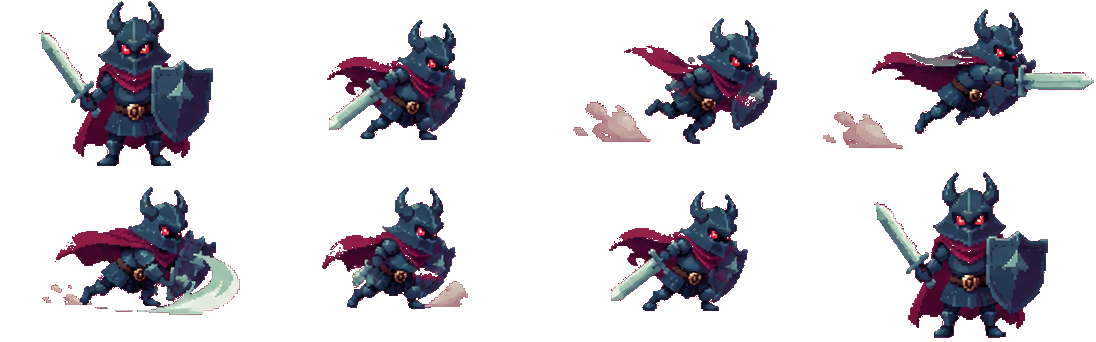

Pixler exposes its generator to code in two ways. The remote MCP server at mcp.pixler.dev gives an AI coding agent six tools — generate, edit, animate, get_job, list_jobs and get_quota — so a request like "make a 64×64 knight, animate an 8-frame walk cycle and save it to assets/sprites" turns into real PNG files in your project. The REST API at api.pixler.dev/api/v1 runs the same asynchronous jobs from scripts, build pipelines and your own tools, with an OpenAPI document and an interactive explorer. Both use a scoped token and the same credit balance as the website.
MCP for 10 agent clients
Copy-paste setup for Claude Code, Claude Desktop, Cursor, VS Code, Windsurf, Zed, Codex, Gemini CLI, OpenCode and Warp. The server uses Streamable HTTP with a Bearer token, so any client that supports custom headers can connect.
Six tools, one workflow
generate queues a sprite, item, tile or background; edit redraws a finished image from an instruction; animate turns an image into a 2–16 frame sprite sheet; get_job, list_jobs and get_quota let the agent wait for results, reuse earlier art and check its balance.
REST API with OpenAPI
POST /generate, /edit and /animate return a job id; poll GET /jobs/{jobId} until it completes, then download each PNG from /jobs/{jobId}/images/{index}. GET /quota reports credits and free job slots. Errors use stable codes such as 429 concurrency_limit with Retry-After.
Scoped tokens, shared balance
Create tokens on your account page and give each one only the permissions it needs — generate, edit, animate or read. API and MCP are included on every plan: one credit per image, five per animation, from the same balance as the website.
Frequently asked questions
Which coding agents are supported?
Pixler has setup guides for Claude Code, Claude Desktop, Cursor, VS Code, Windsurf, Zed, Codex, Gemini CLI, OpenCode and Warp. Any other MCP client that supports Streamable HTTP and a custom Authorization header works too.
What can the agent do?
Generate characters, items, tiles and backgrounds; edit a finished image with an instruction; animate an image into a sprite sheet; poll and list jobs; and read the remaining quota. It can then download the PNGs into your project.
How much does API and MCP access cost?
Nothing extra — it is included on every plan and uses the same balance as the website: one credit per image and five per animation. Rare is $8/month for 800 credits, Legendary $20/month for 2,000.
How many jobs can run at once?
One active request on Rare and two on Legendary, shared between the website, API and MCP. A request counts once however many images it makes. Over the limit, REST returns HTTP 429 with code concurrency_limit and a Retry-After header.
Is the API synchronous?
No. Every call queues a job and returns its id. Poll the job until it is Completed, then download the images or the animation sheet. Agents do this automatically with get_job.
Are there limitations?
Reference images are web-only for now, and OAuth is not supported — authenticate with a Bearer token from your account page.
Ready to make some pixel art?
Sprites, items, tiles, backgrounds and animation in one place.
Open generator